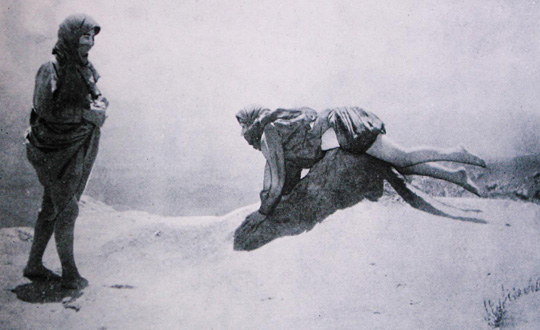
Late 19th century fertility rites at the Portakar, Southern Armenia, South-West Asia.
Hail, ye Refusenik Hordes, ye Seekers both Descent & Iridescent,
As so many of you have really warmed to my positive discussions on how to make Vision and Vision States work in the everyday world, I’m gonna continue the next coupla Drudions with some brief studies of how thin the veil often is between we Moderns and our ancient ancestors. For, as I commented last month, many Visions often have less to do with the Visionary’s being struck by some Lightning Bolt of heavenly revelation and more to do with that Visionary’s determination and persistence, nay, refusal to give up on something that they believe to have glimpsed. Before I do this, however, I’m gonna use this April Drudion to discuss how the Visionary, the Seer, even the amateur out stalking the ancient hollow ways, may find their accidental – but nonetheless important – discoveries shunned by the scientific communities, only to be later re-discovered by the scientists themselves. For the modern so-called Scientific world often obscures the role of the Visionary simply because Science’s worldview will not allow due credit to be given to such ‘untutored’ people. For myself, the most notorious example happened at Stonehenge back in 1953, when 10-year-old David Booth discovered the now famous carving of an axe on the outer face of one of the massive trilithons. At the time, all credit was given to the little boy, and his discovery was dutifully published on page 31 of STONEHENGE, the book written by the chief excavator R.J.C. Atkinson. Whizz forward a couple of decades, however, and most people were crediting the finding of the axe carving to Prof. Atkinson himself, despite his having been totally honest about who the real discoverer was. It’s a clear example of modern secular society inadvertently making priests of its scientists and specialists, as though we Godless Westerners still somehow NEEDED the discovery to have been made by an ‘official’, in order to render it more valid. Another similar occurrence happened not long ago to a friend of mine, the researcher Pete Glastonbury, who regularly contributes to our Modern Antiquarian forums. Walking down the long West Kennett stone avenue one day, Pete suddenly noticed that one of the megaliths had been re-erected upside down back in the 1930s, and dutifully reported this to a local archaeologist. However, all the national newspapers chose to credit the archaeologist himself with the discovery, and Pete’s name was not even mentioned. In a similar incident back in June 2003CE, while engaged in research for my enormous tome THE MEGALITHIC EUROPEAN, even I found myself unwillingly placed in the role of ‘specialist’ while travelling in southern Armenia quite close to the Iran border. I had long been determined to find a ritual stone known as the Portakar, or ‘Doorway Stone’, having been sent a late 19th century photograph of the monument almost a decade earlier. The Portakar stone had been used as a place of fertility rites by women down the ages, until the practise was stamped out by the pre-WW2 Soviet authorities for being too pagan. Anyhow, my driver Mher, my translator Zareh Tjeknavorian, his young wife Alina and I scoured long stretches of the so-called Iran Highway (a potholed 2-lane cement nightmare), but no locals had even heard of the stone. Eventually, after umpteen false trails and blind alleys, we met a 70-year-old shepherd whose grandmother had told him, at the age of eight, that the Portakar was ‘up there’, at which point he gesticulated to a rocky outcrop 600 metres hence. Struggling uphill in the 113˚ heat, we soon discovered that this was – once again – most certainly not the Portakar. Struggling back down to the shepherd, my translator Zareh overheard the old man admit to his 15-year-old grandson that he’d never even bothered to go there himself! All 600 metres away! We did, however, all agree that the hilltop village on the horizon was the same as that in the 19th century photo. At this point, the teenage shepherd took Alina by the hand and headed off northwards. Both Zareh and I believed he’d just taken a shine to her and wished to prolong our visit. Still, we’d got nothing to lose and off we trotted 100-150 metres behind them. Within 10 minutes, Alina was dancing up and down on the near horizon and the Portakar had been re-discovered … just thirty feet from a single-track ox path, which had – we later discovered – been the old Iran Highway! Even more strangely, as we headed back to our car to return to our lodgings, the old shepherd and his grandson both hugged me and said I had brought great honour to them and their village by restoring the Portakar to them; an ancient monument which had – just one hour previously – meant so little to their culture that its existence had been entirely forgotten. As an Englishman pursuing his Vision, however, I had somehow made this rocky outcrop valid once more, even though – as I carefully pointed out – I had NOT been the one to find it. Just as 10-year-old David Booth’s discovery became attributed to Prof Atkinson, I somehow found myself (as the representative of the Scientific West) being credited with the discovery both by the grandfather and grandson alike. Life is full of role-playing, and I had to accept that role in order for these Armenian shepherds to validate their own discovery. Nevertheless, that incident showed me (as active members on the forums of Head Heritage’s Modern Antiquarian.com are constantly discovering) that the Bible was (shock, horror) remarkably accurate when, in Luke 11.9, it states: “Seek, and ye shall find.” Ain’t it strange, but ain’t it the truth?
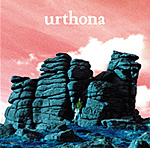
I REFUTE IT THUS by Urthona
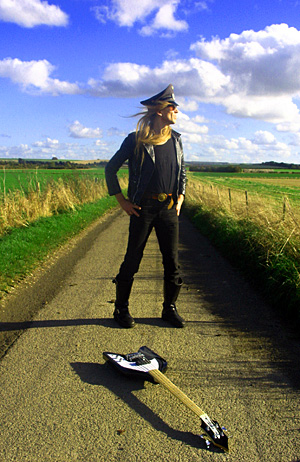
Okay, let’s now move on to the practical side of the trip. This month’s reviews start off with a real rarity … a new release from our own Head Heritage label, motherfuckers, and what a release it is! I REFUTE IT THUS is the vast distorto-guitar vision of one Urthona, a solo metal headcase – from Devizes, Wessex, no less - with an ear blistering sound that channels the chatter of the long-dead ancients up through the neck of his axe and drip feeds it into the Collective Unconscious. Three enormous tracks populate this debut, commencing with an Ur-garage racket that conjures up visions of the Barrett Floyd hammering T. Dream’s early 45 ‘Ultima Thule’, before plateauing out into two exceedingly beautiful and enormously vast eternities of axe overload, ernie-ernieing seagull dives, digital distortion and microphonic feedback somewhere along the lines of Nadja, To Blacken The Pages and the Angelic Process, but even better and even more useful. Honest Injuns, kiddies, this is huge stuff indeed, and all in a sumptuous Dartmoor fold-out package worthy of the Head Heritage mothership. As if ye couldn’a guessed by now; HH22 is a motherfucker. Grab your copy by pressing
here, and watch the so-called real world sod off bigtime.
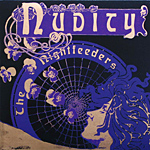
THE NIGHTFEEDERS vinyl LP by Nudity
Next, reserve yourself a place in your LP collection for the incredible new 12” purple vinyl monster from Nudity, those killer guitar heroes led by Monseigneur Dave Harvey, former lead guitarist with Tight Bro’s From Way Back When. I know I’ve already bigged up this band before, but I ain’t even started, motherfuckers. For not only is D. Harvey one of only two whiteys who can hit me with a raga and make me want more (TiMOTHy Revelator is the other), Harvey’s also a percipient enough motherfucker to have boosted the band’s personnel to new heights by adding former Tight Bro’s fellow guitarist Quitty on bass, thereby bringing the current Richter Scale stature of this ensemble to ‘Overfloweth’. And while side one clocks in at twenty-one minutes of early (TNT-period) DC as played by Amon Düül 2, side two sports a re-mix/re-model by Fucking Champs hero Tim Green, thereby stuffing even more sonic overload into the grooves. Once Nudity get their first full album up-and-running, I know all Hell will break loose cause they’ze already majorly there with this release. So don’t just kick your heels and wait for Nudity to come to you, head to
www.killrockstars.com and demand one of these exquisite purple vinyl delights and pronto, Tonto!

LICHTBUCH by Jahrtal
Those of you with a constant Jones for dark Germanic folk of the post-Krautrock post-Pilz Records variety should certainly avail yourselves of a copy of LICHTBUCH by Jahrtal, a duo led by multi-instrumentalist Ewald Spiss and accompanied by his muse Christine. Across twelve intimately recorded songs (including both Ewald originals and traditional English, Scots and German ballads) Jahrtal’s extraordinary melancholy permeates the room and electrifies the listener, as Herr Spiss spreads picked Spanish guitar, dulcimer, lute, psalter and organ across an enthralling hour of music. Mostly comprised of long songs of a 5-10-minute duration, the most obvious references for Jahrtal’s sound would be Witthuser & Westrupp and Sergius Golowin’s LORD KRISHNA VON GOLOKA. However, Ewald Spiss’s northern sound is entirely timeless and also reminiscent of some of the Danish and Swedish folk released on the Goddamn I’m A Countryman record label that I’ve been reviewing over the past years. Nevertheless, Jahrtal is –once again – brought to you care of those forward-thinking motherfuckers at Austria’s superb Ahnstern label (
www.steinklang-records.at), home of Sturmpercht and Allerseelen. Again I salute ye, gentlemen.
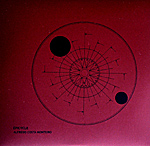
ÉPICYCLE by Alfredo Costa Monteiro
Okay, as regulars to this reviews section will by now have guessed, whenever I have a yen to opt out of life and crawl into the back of my mind, I often find Israeli noise the most suitably discomforting. However, I have this month been fending off psychic attack with the slightly less offensive sounds of ÉPICYCLE by the Portuguese artist Alfredo Costa Monteiro. An enormous and diesel-powered Soviet space freighter low on fuel and crewed by North Korean retards so Luddite they think the remains of last night’s rice supper might get the engines sputtering into life again, that’s what this record sounds like. For endless repetition only, this one. Unfortunately, at least from what little I know about Monteiro, this new release appears to be highly unrepresentative of his regular style. Well all I can say is this shit stinks so bad we need several latrines-full more. Bring on the boxed set, Lord Alfredo, and don’t forget the accompanying free largactyl syringe! In the meantime, this icky ointment is available on Barcelona’s Etude Records, and can be purchased at
www.myspace.com/etuderecords.

RETROSPECTIVA by Sangre Cavallum
Continuing awhile on the Portuguese theme, the mighty Sangré Cavallum have just made another mighty statement with their 3-CD boxed set RETROSPECTIVA (2005), a huge collection of field recordings, lo-fi demos and superb unreleased tracks. The whole schmeer hangs together brilliantly, the flutes and marching drums evoking barely populated mountainsides inhabited by stern-eyed men on a mission. Like the bombast of the massed Breton bombarde bands, the Cavallum exists only in the braying midrange - great for hotel nights when you only brought a ghetto blaster with one 2” speaker. Hell, kiddies, this might just be my favourite album thus far released by Sangré Cavallum, and it all comes in a hefty wooden box replete with scary carved miniature mask inside! Once again, cop your load from those industrious representatives of Farmagud at Steinklang (
www.steinklang-records.at).
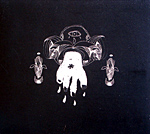
PUFF by Blues Control
Finally, re-issue of the month must surely go to Blues Control’s PUFF, finally making its CD debut on Chris Freeman’s excellent Fusetron label (
www.fusetronsound.com) after having previously been available only on the obscure Woodsist vinyl-only label. Despite Blues Control’s name, this slab o’ mung worship bears about as much resemblance to the blues as the New Lou Reeds do to their own namesake, ie: Zilch! I’ve always preferred to spin side two first, as the sub-microcephalous idiot bass riffage of ‘Behind the Skies’ sounds like something Asahito Nanjo woulda scraped off a Tokyo pavement and inserted in an early High Rise LP. Compulsive, repulsive, degraded and totally essential to thy library. Thereafter, the album plummets into that horribly more-ish zone where Zippo Zetterlink woos and impregnates MEET THE RESIDENTS and, while the resulting baby grows up healthy and strong, the resultant afterbirth is left to co-agulate on a cold slab. Blues Control is THAT co-agulated afterbirth.
And with that, I shall sod off for another month, pausing only to announce a one-hour-long lecture on Heathenism & Paganism that I’ll be making at Birmingham Town Hall, on May 26th (a Bank Holiday Monday). The show will also include a screening of the legendary 1922 Scandinavian silent movie HAXAN (a bizarre documentary about witchcraft through the ages, including some hideous/humorous re-enactments) with a live soundtrack performed by the Bristol duo Bronnt Industries Kapital. Until next month, then, as these warm Spring days lengthen and the Wessex lambs briefly enchant this country dweller’s life, good luck with your own lives, and don’t let the Greedheads & Priests drag ye down!
Love und Action,
JULIAN (Lord Yatesbury)